In today’s business environment, resilience isn’t just a competitive advantage—it’s essential for effective leadership.
In this article, explorer, architect, and leadership speaker Kevin Vallely shares lessons from one of the most challenging expeditions on Earth and explores what they reveal about leading through uncertainty, disruption, and change. Drawing from a 500-kilometre unsupported ski traverse across Canada’s High Arctic, Kevin offers a compelling perspective on why the strongest leaders protect what matters most, steady their teams, and continue moving forward when conditions are at their toughest.
Risk and Resilience: Navigating a Fractured World
“Oh shit.”
We’ve just finished setting up our first camp when the wolves appear.
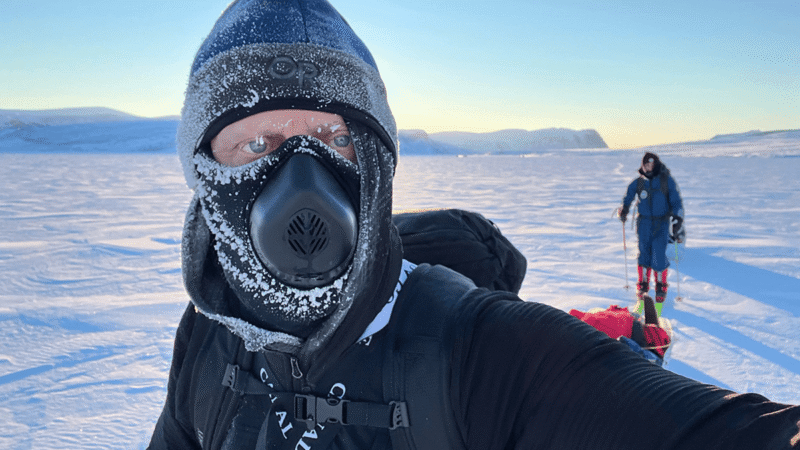
Ray Zahab and I are four hours into a 500-kilometre unsupported ski traverse of one of the most remote places on earth: Ellesmere Island, a frozen island in the Canadian High Arctic so untouched it feels closer to the moon than a place on earth. Ten large Arctic wolves are moving silently out of the whiteness, directly toward us.
Ray glances at me.
“Do you think we need to be worried?”
“Don’t know,” I say, my pulse spiking.
The wolves are all around us now.
They spread out with the easy confidence of creatures that have never had to fear anything. One stands just ten feet away. It doesn’t seem to make eye contact so much as look through us, as if focusing on something beyond. Its body language is calm, almost curious, completely in control.
Here we are, two humans on a frozen island at the top of the world, surrounded by a pack of wolves that could dismantle us in seconds if they choose to. What’s strange isn’t the fear we feel, but the absence of it. We watch, calmly, as one by one they slowly lope out of view.
That strange calm in the presence of something genuinely unpredictable and dangerous is exactly what effective leadership requires right now.
Three Years to Get There
Reaching that moment took three long years for Ray and me.
A failed attempt in 2022 was followed by Ray’s cancer diagnosis in 2023. Amazingly, we kept on track for 2024, only to find ourselves $62,000 in the hole just weeks before departure when a key flight sponsor unexpectedly backed out. We spent three years trying and three years coming up short.
Walking away would have been easy. No one would have questioned our decision. But we had never intended the journey to be easy.
In 2025, everything finally aligned. We spent seven gruelling days on snowmobile just to reach the start – the remote weather station at Eureka – and within hours of our departure, the wolves found us.
I tell this story not to be dramatic, though ten Arctic wolves facing you down in -36°C is objectively dramatic, but because the shape of our Ellesmere journey mirrors what many leaders are facing today.
The World Has Cracked Open
We are living through a period of compounding disruption unlike anything most leaders have experienced in their careers: geopolitical fractures, supply chain fragility, tariff uncertainty, AI rewriting everything.
The world isn’t just changing, it’s cracking. And the cracks are spreading faster than most organizations can patch them.
Many experts suggest that today’s pace of change may be the slowest we’ll experience for the rest of our careers. Massive change and uncertainty will be the new normal.
So how do we navigate it?
Here’s what more than two decades of operating in the world’s harshest environments has taught me: cracks aren’t the problem. How you respond to them can be.
In fractured conditions, leadership comes down to three things: protect the core, steady the culture, and keep moving.
Protect the Core
Before I was an explorer, I trained as an architect. One of the first things you learn in practice is to hold your original concept tightly, because everything will come for it.
Zoning bylaws, engineers, the client, the budget. Each arrives with a reasonable request to modify or soften what you envisioned. Individually, each compromise seems harmless. Together, they can leave you staring at something that bears no resemblance to what you set out to build in the first place.
The skill to navigate this isn’t stubbornness. It’s knowing the difference between refining a vision and quietly giving up on it.
Leaders face the same pressure today. The many uncertainties around us can nudge a leadership vision further and further from its original intent until you’re executing a plan that no longer resembles the one worth executing.
In a fractured world, the first job of leadership is to know what you are protecting.
Steady the Culture
On day twelve of our Ellesmere journey, I unzipped the tent door and found myself face to face with a huge Arctic wolf. I froze, then slowly stepped out as nine wolves moved around us. One stood very close and motionless while the others drifted past.
Weeks later, Terry Noah, an Inuit knowledge-keeper and friend, explained what we’d seen in this encounter. The still wolf that checked us out is the sentry, the one the rest of the pack watches. “They key off his body language,” Terry says. “If he’s relaxed, they’re relaxed. If he’s aggressive, then there’s trouble.”
This wolf stared at us calmly through yellow eyes ringed with frost. “He’s not the alpha,” Terry later continues. “He’s the young up-and-comer. The alpha is the one out front setting the pace.” And, sure enough, one wolf trotted ahead without looking back, maintaining tempo for the group.
Two distinct leadership roles. One holds the culture while the other sets the pace. When those two things are out of sync, the pack fractures.
Organizations are no different. It is not enough to move focused and fast. Someone must also steady the team and signal calm. Someone must make sure the pace of the work does not outrun the trust of the team.
In uncertainty, people listen to what leaders say, but more importantly, they watch what leaders do
Keep Moving Forward
Twenty-eight days after leaving Eureka, Ray and I skied the final stretch into Grise Fiord, Canada’s northernmost community. We didn’t feel a sense of conquest, only calm. After three years of setbacks, we arrived by following the simplest rule in the Arctic, and the most important one of all: keep moving forward.
The world is fractured right now, and, there’s little doubt, it will keep fracturing. That’s not cause for alarm. Every period of disruption is also a period of extraordinary opportunity for leaders willing to move while others are frozen.
Know what you’re protecting. Align the people who hold the culture with those who set the pace. And when everything around you says stop, keep moving.
The wolves do.
They always have.
Continue the Conversation
Kevin’s insights don’t stop here.
Watch the full webinar as TEC Canada’s Director of Marketing, Colten Esser, sits down with Kevin Vallely to explore the stories behind this article and discuss practical leadership strategies for navigating uncertainty, building resilient teams, and leading through disruption.
Watch the full webinar: https://youtu.be/rc5f2BAbNN0
To learn more about Kevin Vallely, his expeditions, books, and keynote speaking, visit: https://www.kevinvallely.com/